*Sponsorship for pollinators
When sponsoring pollinator-biodiversity related initiatives within your local community ensure your business sponsorship is eliciting an All-Ireland Pollinator Plan (AIPP) evidence-based action and include the following:
- Always retain existing biodiversity areas e.g., Avoid removing a meadow to plant native trees.
- Ensure ongoing pollinator-friendly management of habitats is considered.
Consider the following 8 steps as part of your decision-making process to ensure the sponsor recipient is identifying and taking a suitable AIPP action, mapping the action on Actions for Pollinators GIS and then beginning to track if the action is working through Flower Insect Timed Counts.
1. Check out what is already happening in your local area through the local Biodiversity Officer and the Local Biodiversity Action Plan.
2. Review the ‘Recommended sponsorship activities’ table Page 24 of Businesses: actions to help pollinators.
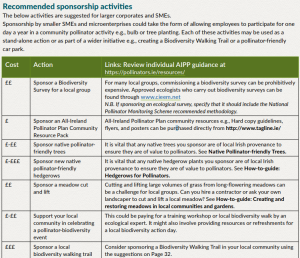
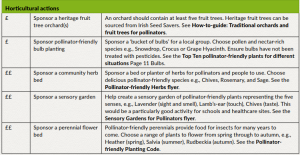
Your business might also consider sponsoring a Community Biodiversity Action Plan which would be uploaded for reference to Action for Biodiversity.
Other ideas include ‘thematic’ places for pollinators such as herb, moon (Page 9), rain or sensory garden / planters/pots or car parks.
Read more here: Communities » All-Ireland Pollinator Plan (pollinators.ie).
Also review the Procurement table (Products/plants and services) Page 29 of Businesses: actions to help pollinators to ensure you are not sponsoring anything which is not in line with the AIPP.
Sponsorship by smaller SMEs and microenterprises could take the form of allowing employees to participate for one day a year in a community pollinator activity e.g., bulb or tree planting.
3. Consider sponsorship channels such as Tidy Towns, the GAA Green Clubs or Biodiversity in Schools. Or go directly to a local community centre or local school.
N.B. Contributing to your local Tidy Towns Committee will mean you will be able to support their application for the ‘Pollinator Award’ judged by AIPP. The Tidy Towns submission date is normally the first week of June annually so consider approaching a group in March.
4. Provide the sponsor recipient with the relevant AIPP guidelines such as:
- Local Communities
- Sports Clubs – e.g., engage directly with a local GAA Club who follow the Green Clubs Tool kit (Biodiversity). N.B. The AIPP and the National Biodiversity Data Centre worked with the GAA on the Biodiversity section.
- Schools also check out other sponsorship through Biodiversity in Schools (Pollinator Project and Outdoor Classroom).
- Golf Courses and Faith Communities
- There may also be opportunities to support Residents’ Associations and Business Parks for pollinators.
5. Also invite the sponsor recipient to use the AIPP companion planting and maintenance resources resources e.g., Top Ten pollinator-friendly plants for different situations and the Pollinator-friendly planting Code. Also suggest they choose alternatives to pesticides, herbicides and insecticides by reviewing the Pesticide Alternatives: A Summary.
6. Encourage the sponsor recipient to map their actions on Actions for Pollinators (biodiversityireland.ie) GIS.
7. Suggest the sponsor recipient do Friday FIT Counts (Flower Insect Timed Counts – entry level/no experience necessary) to see if the actions you are sponsoring are working over time.
8. Consider the sponsorship as an annual initiative in which your business participates to create momentum over time. In this move towards nature-positive do consider aligning with the AIPP Key Campaigns & Messages, published annually in January, and follow us on socials X:@PollinatorPlan and Insta: @allirelandpollinatorplan. Consider key pollinator dates such as: World Bee Day (20 May), Biodiversity Week (May) etc.
National sponsorship or funding national pollinator research
If your business is considering national sponsorship check out Action 24 (Page 25) of Businesses: actions to help pollinators. If thinking about funding pollinator research review Action 33 on Page 29 of Businesses: actions to help pollinators.
REMEMBER
Why we don’t recommend wildflower seed mixes » All-Ireland Pollinator Plan (pollinators.ie)
Remember sowing wildflower seed mixes as an ornamental meadow/strip using e.g., seed ball type products/packets or bulk purchases, is not a pollinator-biodiversity action. Non-native mixes may contain Black Grass potentially devastating for our agricultural land. Native mixes may have a high percentage of annuals and may need re-sown the following year.
Instead, encourage reduced mowing AND lift the cuttings to support ~1400 species of invertebrates Page 6 comparison table How-to-guide: Creating and restoring meadows
Choose an alternative action to honeybee hives
Managing honeybee hives is not a biodiversity action. The honeybee is a managed pollinator and not under threat on the island. To have a hive is a wonderful hobby, but, increasing numbers may create competition for food.