AIPP 2026-2030
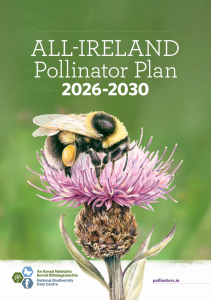
On 9th July 2026, the new All-Ireland Pollinator Plan 2026-2030 was launched at the National Botanic Gardens, Dublin, by Ireland’s Minister for Nature, Heritage and Biodiversity, Christopher O’Sullivan TD, and Andrew Muir, Minister of Agriculture, Environment and Rural Affairs, Northern Ireland.
The All-Ireland Pollinator Plan 2026-2030 is a five-year road map that aims to transform our landscape to help pollinating insects like wild bees, hoverflies and moths, and wider biodiversity. Building on the success of the first two phases (2015-2020 and 2021-2025), this AIPP is even more ambitious, with more partners coming together to deliver more actions and manage our whole landscape to permanently support our struggling biodiversity.
This next phase is supported by the Government of Ireland Shared Island Fund; Department of Agriculture, Food, and the Marine; the National Parks and Wildlife Service; and the Northern Ireland Environment Agency.
The All-Ireland Pollinator Plan is managed by the National Biodiversity Data Centre.
The overall vision: pockets of nature every 200 metres
The overall vision of the AIPP 2026-2030 is an island with pockets of nature every 200 metres. A solitary bee won’t fly more than about 200 metres to find food. Imagine an island where there are pockets of nature every 200 metres in our landscape, providing food, shelter, and safety for pollinators. That is our vision: an island that supports biodiversity, is climate resilient, and brings us the joy and health benefits of connecting with nature.
A new structure with greater flexibility
Based on public and stakeholder consultations during 2025, 50 strategic aims and 75 success metrics have been identified across 10 work packages, which will be reported annually to ensure accountability and transparency.
Together, these work packages aim to drive landscape-scale change, connecting individual actions into a coherent ecological shift towards an island where pollinators can survive and thrive. Each has clear aims and a series of success metrics to transparently track progress. This structure provides greater flexibility and will allow key areas the room to grow and evolve over the next five years. It also facilitates better knowledge exchange and peer-to-peer learning within sectors.
A steering group with representation across both jurisdictions will provide oversight. Each of the 10 work packages has a representative within the Steering Group.
Find out more about the vision for each work package below. Click on the title of a work package to learn more about it’s aims, its partner organisations, and progress in each area to date.

Thriving populations of wild pollinators are sustained across farmland. Farmers understand what pollinators need and are actively engaged in preserving and enhancing suitable habitats on their farms. Ongoing monitoring is used to determine the diversity and abundance of pollinator populations across a network of farmland sites. Farmers are credited and celebrated for the positive role they play in nature conservation.

Thriving populations of wild pollinators are sustained across land managed by local authorities and public bodies through the cooperation, support, and effort of partner organisations. The sector is supported by up-to-date evidence-based resources, technical advice, and knowledge exchange opportunities. Local authorities and public bodies are recognised for their role in protecting pollinators and the wider benefits this brings to society. Ongoing monitoring is used to determine the diversity and abundance of pollinator populations across a network of sites.

Thriving populations of wild pollinators are sustained across land managed by transport authorities and utility companies. Transport and utility networks are managed to act as ecological corridors for nature where possible. Partners are working together to create interconnections between networks, allowing pollinators to move across the landscape.

Thriving populations of wild pollinators are sustained in local communities. Across the island of Ireland, a wide range of community groups are working together to protect, enhance, and create habitats with food and/or shelter for pollinators at 200-metre intervals in cities, towns, villages, and rural areas. As well as transforming the landscape for pollinators through evidence-based actions, these efforts are helping to improve human health and wellbeing in our communities. Communities are recognised and celebrated for their role in transforming the landscape for pollinators.

A wide network of businesses manage their sites for pollinators and are aware of the All-Ireland Pollinator Plan as a framework for their activities. Evidence-based pollinator actions are embedded in the governance, communication, and sponsorship activities of businesses. Streamlined progress reporting ensures accountability and helps to highlight the positive contributions of this sector to pollinator action.

The island of Ireland is home to thriving populations of rare pollinator species that are supported by interconnected sites. Land managers are actively engaged in conserving rare and threatened pollinators, and there is greater awareness of the importance of semi-natural habitats for pollinating insects. Annual monitoring is used to track changes in pollinator populations, and increasing numbers of species show recovery.

Actions for Pollinators is a state-of-the-art GIS-based online mapping system that transparently tracks collaborative efforts across all sectors to create a pollinator-friendly landscape. Publicly accessible and easy to use, it facilitates social connections and helps drive collective action to create nature corridors. It is an essential tool for enabling the All-Ireland Pollinator Plan’s overall goal: an island with pockets of nature every 200 metres-

The All-Ireland Pollinator Plan is underpinned by a long-term monitoring scheme in operation across the island of Ireland, annually tracking changes in populations of wild bees, hoverflies, and moths using scientifically rigorous methods. This structured monitoring scheme is supplemented by citizen science pollinator monitoring initiatives, which are promoted as tools to assess the impacts of local restoration. Taxonomic capacity is increased by supporting those who want to upskill in pollinator identification.

Irish research into the drivers and consequences of pollinator loss, pollinator health, and the most effective ways to restore pollinators across landscapes, is world-leading and contributes to effective solutions for policy and practice in Ireland and beyond. There are adequate funding opportunities, and researchers work collaboratively to help drive the best outcomes for pollinating insects.

Across the island of Ireland, there is wide-scale public awareness of the most important pollinating insects – their value, status, and the threats they face, as well as the evidence-based actions required to help them. Within and beyond the target audiences of the All-Ireland Pollinator Plan, there is extensive awareness of and interaction with the Plan, and broad public understanding of its impact. There is greater appreciation for the wide-ranging benefits of biodiversity, including to human health and wellbeing, with strong public support for pollinator conservation initiatives at all levels.
NOTE: All the evidence-based resources developed in the first phase of the Plan still stand. Where necessary, they will be gradually updated during the coming years.