
How can we create better nesting habitat for solitary bees? Colm O’Leary, a PhD researcher at University College Dublin, tells us about his research.
This blog is part of the ‘Dispatches from Researchers’ series, which features guest articles written by experts in pollination and related fields.
When we think of ways to help bees and other pollinators, we often think of wildflowers, meadows, and hedgerows. However, we can overlook another important requirement: bees need suitable places to nest. Solitary bees make up the majority of Ireland’s bee species and, depending on the species, they may nest in burrows in the ground or in existing cavities above ground. Of all Irish solitary bees, the majority nest in the soil (approximately 80%), while the remaining species nest above ground in cavities such as hollow plant stems, holes in dead wood, or even empty snail shells!
Unlike social bees, such as honeybees and bumblebees, solitary bees do not live together in large colonies. A female solitary bee typically finds a suitable site, creates or occupies a nest, then lays her eggs and provides enough pollen for each developing larva to complete its development. Without suitable places to nest and raise their young, solitary bee populations cannot persist, so nesting habitat is therefore an essential piece of the puzzle when it comes to supporting solitary bees.
Providing artificial nesting habitats, such as bee ‘hotels’ and areas of exposed soil, are increasingly used to support solitary bees. However, simply providing these features does not guarantee that bees will use them. We still know much less about the nesting requirements of solitary bees than we do about their needs for flowers, including how nesting habitats should be created and where they should be located.
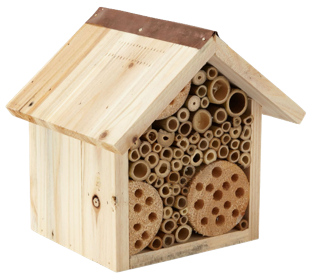
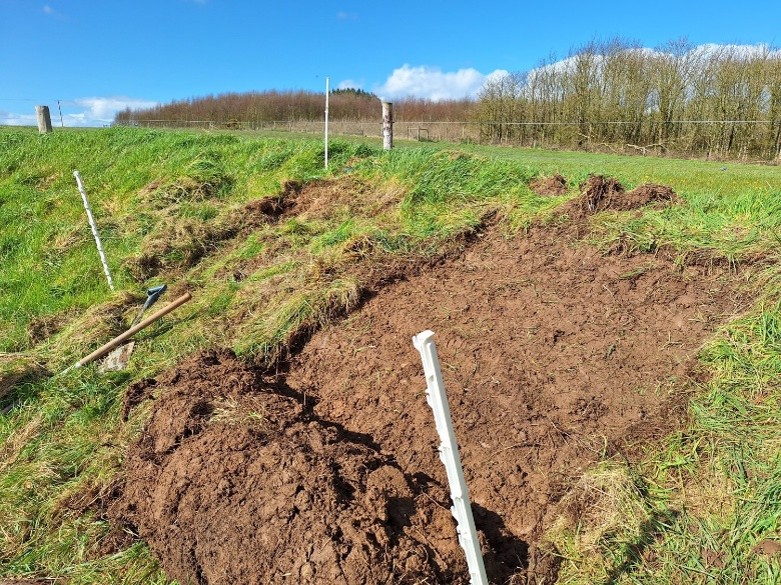
As part of a collaborative research project between Teagasc and University College Dublin, we investigated the nesting requirements of below ground and above ground nesting solitary bees, and then considered how this information could be used to improve conservation schemes on Irish farmland. We reviewed existing research, studied areas already being managed for ground-nesting bees, experimentally created patches of bare soil for bees to nest in, and tested how the positioning and design of bee hotels influenced their use.
Key findings
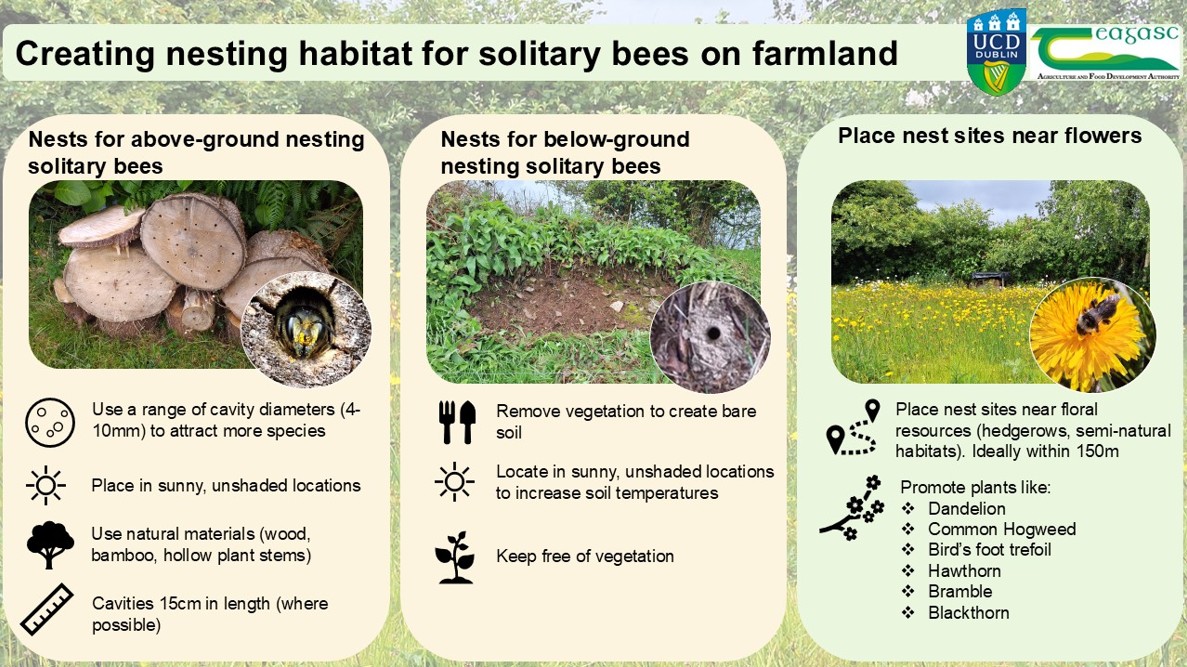
- Creating bare soil can provide nesting habitat. Our experiments showed that relatively simple measures, such as removing vegetation to expose the soil underneath, can encourage ground-nesting solitary bees. In one experiment, 158 of the 159 solitary bee nests we recorded were in areas of bare soil, compared with just one nest in similar vegetated plots. This suggests that creating and maintaining small areas of exposed soil could supplement the naturally occurring nest sites for solitary bees in farmland.
- Warm, sunny locations appear particularly important. Across our studies, shade was consistently associated with lower nesting activity. Bee hotels in unshaded locations were over 10 times more likely to be used than those in shaded areas, while ground-nesting bee nests were more abundant in less shaded areas compared with shaded sites. Together, these findings suggest that nesting habitats should generally be created in sunny, open locations, away from shade caused by trees, walls, and hedges.
- Different bee species have different nesting requirements. Our experiments with bee hotels clearly demonstrated that different species of above-ground nesting solitary bees have different nesting preferences. For example, large leaf cutter bees (Megachile spp) tended to use the widest nest cavities offered (10mm), whereas the much smaller white-faced bees (Hylaeus spp), tended to use much smaller cavities (4-5mm diameter). Therefore, by providing bee hotels with a variety of cavity sizes we can create nesting opportunities for a wider range of solitary bee species.
- Nesting habitat needs to be considered alongside flowers. Our review of existing research revealed that nesting habitat should not be considered in isolation from the surrounding landscape. Female solitary bees need access to pollen and nectar while constructing and provisioning their nests, and many species have relatively limited foraging ranges. Providing suitable nesting habitat close to flower-rich areas helps the bees access everything they need to complete their life cycle within a relatively small area.
Simple actions, close to a food source
Overall, our findings show that relatively simple actions could increase nesting opportunities for solitary bees on farmland. Patches of exposed soil can be created in sunny, relatively unshaded locations and maintained to keep them free of vegetation. Bee hotels can also be positioned in open, unshaded locations, and designed to provide a range of cavity sizes to accommodate different bee species. Importantly, nesting resources should be located close to good sources of pollen and nectar, such as flower-rich field margins and hedgerows.
Although providing appropriate flowers remains essential for pollinator conservation, flowers are only one part of what solitary bees need. Considering where bees can nest, as well as where they can find food, will provide resources for a wider range of species and ultimately make farmland pollinator measures more effective.
About the author

Colm O’Leary is a PhD researcher in UCD and funded under Teagasc’s Walsh Scholars Programme. The aim of his research was to investigate solitary bee nesting ecology and identify how the findings could be used to improve the effectiveness of conservation measures for solitary bees.
Find out more:
Research paper: Landscape and local factors influence solitary bee nesting, but reported effects show little consistency across studies
How to: Creating wild bee nesting habitat
How to help pollinators on farmland