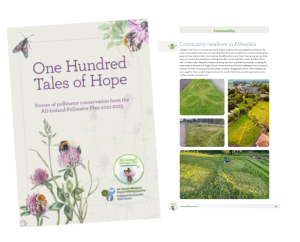
To celebrate World Bee Day on 20th May, the National Biodiversity Data Centre has released a new free booklet shining a spotlight on 100 good news stories of pollinator conservation from across the island of Ireland.
100 Tales of Hope: Stories from the All-Ireland Pollinator Plan 2021-2025 celebrates the hard work of local communities, farmers, councils, schools and businesses, who have transformed their land to help wild bees during the most recent phase of the All-Ireland Pollinator Plan.
Wild bees – bumblebees and solitary bees – are in trouble on the island of Ireland, with one third in decline. Recent data shows this trend is continuing, but local populations are increasing where actions are being taken to help them.
Wild bees pollinate many fruits and vegetables; they are worth millions to our economy, and they ensure the survival of about 70% of our wild plants. Their loss is a problem for the health of our environment, the sustainability of our food production, and the vibrancy of our world.
Tackling pollinator loss
The All-Ireland Pollinator Plan (AIPP) was established in 2015 to tackle pollinator declines, becoming one of the first of its kind in Europe. Now entering its third phase, it is a shared plan of action, bringing together different sectors to encourage everyone to mow less to help native wildflowers grow, protect and plant native trees and hedgerows, eliminate pesticides and choose pollinator-friendly ornamental plants in managed settings like gardens.
In 2025, a poll commissioned by the National Biodiversity Data Centre revealed significant public support for pollinator-friendly actions, with many people changing the way they manage their own gardens. Now more than ever, we are seeing our landscapes differently – from the smallest garden to the largest farm. More people are considering how they can help nature as well as humans, and ultimately how this will benefit us all.
The stories in this booklet provide vital inspiration in a time of biodiversity crisis and serve as an important reminder that even in the face of pollinator declines, there are many reasons to hope. With beautiful illustrations by artist Shevaun Doherty, the ‘tales of hope’ represent people across society, from all sectors and with many different backgrounds, all coming together behind a shared goal to create a landscape where pollinators can survive and thrive.
Transforming our landscapes for nature
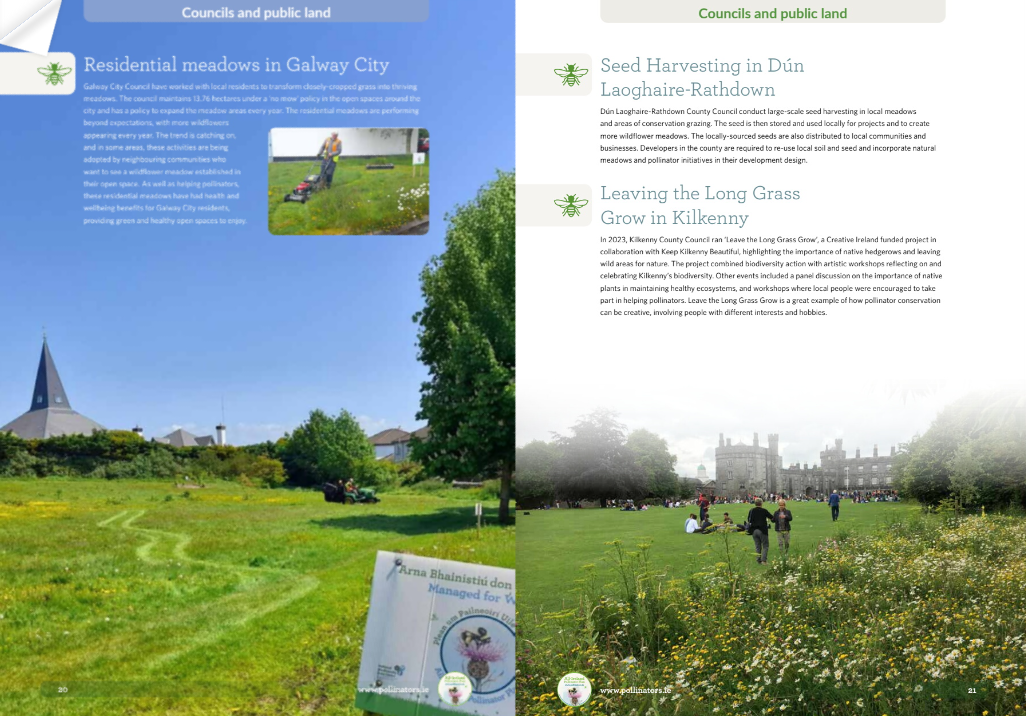
Stories include local community groups who have created urban ‘pollinator pathways’, No Mow May lawn art competitions, and have won prestigious national pollinator awards through initiatives like the Tidy Towns. Others are bringing rare bees back from the brink or helping schools create fertile spaces for learning and biodiversity with vibrant outdoor classrooms. Since 2023, all local authorities on the island of Ireland have signed up as partners to the All-Ireland Pollinator Plan, and tales include their creation of hundreds of hectares of meadows, and establishing ‘pollinator foraging networks’, where “no pollinator will have to travel more than 200 metres in order to find a food source.”
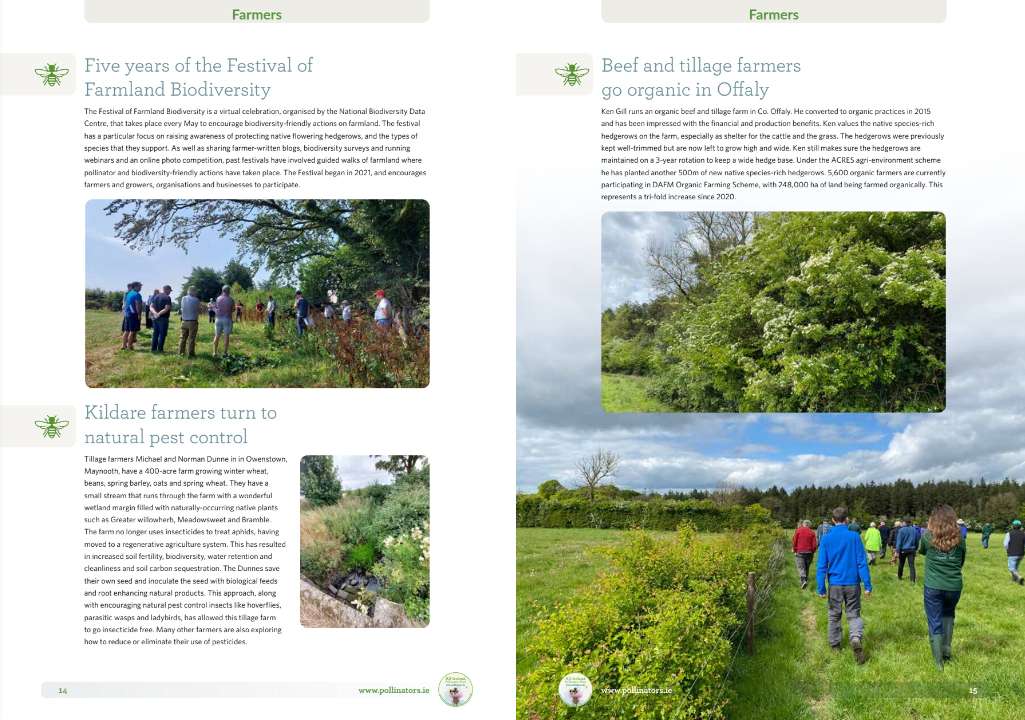
Farmers, too, are working together with scientists to produce innovative ‘pollinator-scoring’ tools to help assess how their land can support pollinators without effecting productivity. The AIPP Business Supporter network has continued to grow, with over 400 businesses of all sizes from a range of sectors agreeing to take evidence-based actions on their land including running biodiversity surveys, developing tailored ecological plans, reducing mowing, creating bare earth banks for mining bees and working with landscapers to protect native hedgerows.
All-Ireland Pollinator Plan co-founder, Dr Una Fitzpatrick said:
“This booklet showcases a tiny fraction of the thousands of people who have made the All-Ireland Pollinator Plan 2021-2025 a reality. It is a celebration of what has been achieved, and a much-needed reminder that we can make a difference if we work together to take the right actions. A huge thank you to everyone who has taken part. Pollinator numbers are in decline, but local populations are increasing where actions are being taken to help them. We know we still have a long way to go to create a pollinator-friendly landscape, but if we have learned anything it is this: what we’re all doing is working – we just need to do more.”
Find the digital booklet here: One Hundred Tales of Hope – Stories of pollinator conservation from the All-Ireland Pollinator Plan 2021-2025
Find out more: